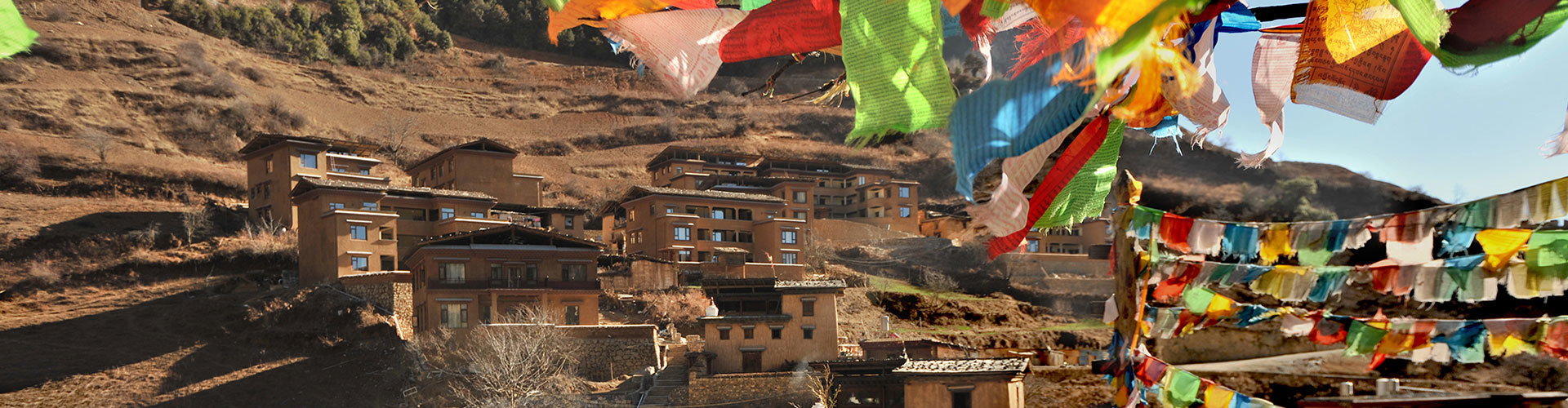
Balagezong

National characteristics
Picture Name

Village Waltz-Nissi Love Dance (I)

2015-12-15

In the Diqing Tibetan area of Yunnan, Nixi Township in Shangri-La County is a hometown of singing and dancing, and the famous Nixi dance originated from this area. The Nixi Love Dance is mainly represented by Tangman Village Love Dance. Each village in Nixi Township has its own unique love dance. The lyrics are roughly the same, but the tone is different. Most of Tangman's tone is longer, which requires a deeper confidence and a higher voice. However, this does not seem to be a problem. People describe the people here as "talking can sing, walking can dance." From the elderly in their 70 s and 80 s to the teenagers, they are all country dancers who love dancing.

Tibetan Rap Art

2015-12-02

In ancient times when the Tibetan people did not have their own writing, they began to use oral rap to artistically reflect their lives, express their thoughts and feelings, impart production and life experience, and express aesthetic concepts and artistic tastes. In Tibetan areas, there are mainly the following varieties of national rap art: ① Lingzhong, that is, Gesar rap; ② Zhong He Zhonglu, that is, rap story; ③ Gullu is the song of Tao; ④ Duiba Harmony, that is, praise and praise; ⑤ 100; ⑥ Lama Mani; ⑦ Folding; ⑧ Tie Nian plays and sings; ⑨ Xia; ⑩ Tibetan Xiangsheng; There are smaller ones like arma, wait. 1. In many epics of Chinese ethnic minorities, Ling Zhong produced about

The World's Longest Epic Story of King Gesar

2015-12-02

The Biography of King Gesar is a heroic epic created by the Tibetan people in China. It was originally an oral literature circulated among the Tibetan people for more than a thousand years and has now been compiled into a book. There are more than 120 books, more than 100 million lines and more than 2000 million words in the book. It is the longest epic in the world. Some people in the world call it "the Homer epic of the East". The Birth of the 1. Epic and Its Significance This immortal epic roughly produced the historical period when the ancient Tibetan clan society began to disintegrate and the slave state regime gradually formed, that is, between the 3rd and 6th centuries A. D.; it was further enriched after the establishment of the Tubo Dynasty (early 7th to 9th centuries A. D.);

Tibetan Ba Ye

2015-12-02

Xianzi, also known as "xianzi", "ye", "ba ye", is a kind of huqin unique to tibetan, generally played by men. Xianzi dance, also known as "Xianzi", is a comprehensive Tibetan song and dance art that integrates song, dance and music with the accompaniment of the instrument Xianzi. Xianzi dance is distributed in eastern Tibet and Tibetan-inhabited areas such as Yunnan, Sichuan and Qinghai. It is an indispensable self-entertaining song and dance in the lives of Tibetan people. There is no fixed place for string dance, but it can become a dance floor in a flat place, such as courtyard dam, roof and room. All lovers, men, women and children can set foot in the dance floor. At festivals, events or major gatherings, people

The Origin of Tibetan Opera

2015-12-02

Tibetan opera, called "Ajram" in Tibetan, is a popular type of opera in Tibetan areas and unique in the motherland's Baihua Art Garden. Origin As for the origin of Tibetan opera, some people are actually associated with the "God of Jumping" initiated by Lotus in Sangye Temple in the eighth century. In fact, the two are not related. In the eighth century, during the reign of Chisong Dezan, after the completion of Sangye Temple, the eminent monk Lianhuasheng invited from Tianzhu, according to Buddha Sakyamuni's doctrine of the four Buddhist tantrums (ministry, ministry, yoga department, supreme yoga department), the yoga department and the king kong dance section in the supreme yoga department, organized the dance of gods, exorciled ghosts and rewarded gods, and opened light to the temple. Lotus

The Origin and Significance of Tibetan Guozhuang Dance

2015-12-02

Guozhuang Dance, also known as "Guozhuo", "Gezhuang", "Zhuo", etc., which means circle singing and dancing in Tibetan, is one of the three major Tibetan folk dances. It is distributed in Qamdo and Nagqu in Tibet, Aba and Ganzi in Sichuan, Diqing in Yunnan and Tibetan settlements in Qinghai and Gansu. "Zhuo has as many tones as there are stars in the sky; Zhuo has as many words as there are trees on the mountain. As much hair as there is on the yak, there will be as much dancing ". This is the praise of the rich Guozhuang dance. Guozhuang dance is actually a kind of happy dance, so whenever happy in the festive season, people regardless of young and old to dance. Such as moving to a new house, getting married and having a wedding, Spring Festival, Duanyang Festival, old men and women

Introduction to Thangka Classification-Bodhisattva

2015-12-02

1. Eleven sides, thousands of hands, thousands of eyes, Guanyin (Sahasrabhuja-Avalokiteshvara) Buddha and Bodhisattva cherish all living beings and give joy as "kindness" (and joy); compassion for all living beings and pulling out suffering is called "sorrow" (pulling out suffering). Eleven thousands of hands and thousands of eyes Guanyin Bodhisattva's fundamental head is kind and white as jade, showing great achievements. The first of the positive has three eyes. Among them, three songs are Zengguang, smiling forever, showing the great cause of prosperity. On top of the three songs are Weifu, with ferocious faces and majesty, showing the great cause of shaking the world. On top of Weifu are the three great achievements of wrath and wrath and wrath.

Sects of tibetan buddhism

2015-12-02

Tibetan Buddhism has a wide distribution in China, with many internal religious schools, many monasteries, many monks and nuns, and a relatively large social impact. It not only has a huge impact on the political, economic, cultural and other fields of Tibetan areas, but also has a great impact on the surrounding ethnic areas. It has also had a certain impact. At present, the following five major sects are mainly popular in Tibetan areas: the Nyingma sect (Red sect) is mainly developed in a decentralized manner. The believers are generally monks at home, settling down, getting married and having children, and not all of them are concentrated in monasteries. Red monks have curly hair and braids, symbolizing countless angry gods. Around the fluffy hair, a symbol of countless empty mother. Red monks wear bracelets, rings, earrings, horns

Mysterious Mani Stone

2015-12-02

"Mani" comes from the short name of the Sanskrit Buddhist sutra "six-character mantra" Om mani beep moo ", which is called" mani stone "because it is engraved with" mani "on the stone;" mani pile "refers to the stone slab or stone piled up with Tibetan scriptures," six-character mantra "or engraved with animal patterns, god images, Langjiu Wang Dan patterns, etc. There are also piles of small stones without any engraved patterns. Tibetan areas of stone "Mani heap" can be seen everywhere, countless. Tibetans have special feelings for Buddhist culture, and men, women and children all take doing Buddhist work as a noble thing. In the vast grasslands, remote ravines, people

Shangri-La Songzanlin Temple Buddha Sun Festival

2015-12-02

Every year on January 15th of the Tibetan calendar, Shangri-La Songzanlin Temple (also translated as "Kadan Songzanlin Temple") will hold an annual grand ceremony to welcome the Qiangba Buddha out of the temple to satisfy the worship of the majority of monks and laymen. The two-meter-high red-copper gilded Qiangba Buddha statue was greeted by more than a thousand lamas and escorted by a guard of honor on the dam behind the monastery and accepted the worship of nearly 20,000 monks and laymen. Jumba Buddha, Maitreya Buddha, is the future Buddha of Tibetan Buddhism "III" Buddha. Kadan Songzanlin Temple, also known as Guihua Temple, is located at the foot of Fuping Mountain in Shangri-La (Zhongdian) County, Yunnan. It is the largest Tibetan Buddhist temple in Yunnan.

Shangri-La Songzanlin Temple Gedong Festival

2015-12-02

The Gedong Festival is a grand ceremony for Tibetan Buddhist gods and dharma protectors to appear on earth. On the 26th and 29th of the Tibetan winter month, local Tibetans came to Songzanlin Temple to watch the lamas dance with masks to celebrate the good harvest and pray for peace and prosperity in the coming year. Xiangba said that these lamas who jumped into the gods had read many scriptures before, and when they jumped into the gods, they all carried Buddha's light on their bodies, and their words were full of devout reverence.

Overview of Tibetan History

2015-12-02

A large number of research results in many disciplines such as genetics, archaeology, history, and linguistics show that: Han and Tibetans share a common ancestor; many prehistoric cultures in Tibet are closely related to the Chinese culture of the same period; the Tibetan Plateau and the inland The economy, culture and politics have always maintained close relations, and Tibet has been an inseparable part of China since ancient times. The Tibetans have a long history, originating from an agricultural tribe in the central region of the Yarlung Zangbo River Basin. According to archaeological discoveries, as early as more than 4000 years ago, Tibetan ancestors lived and multiplied in the Yarlung Zangbo River basin. According to Chinese historical records, Tibetans belonged to the Western Qiang during the Han Dynasty.
< 123 > proceed page